

Seoul Searching - DMZ
- Dec 29, 2018
- 6 min read
Updated: Feb 11, 2019
Tim picked me up yesterday evening from the Incheon Airport. Little did I know, the airport is actually pretty removed from the heart of the city. We took the Seoul subway/metro system to our hotel. It was more complicated then I could have ever fathomed to navigate myself and I was so grateful to have him with me. Most of the signs have English and Hangul (한국말), but that doesn't make navigating the multiline metro much easier. The closest thing I could relate it to was the subway system in New York City, but I remember finding that confusing and overwhelming too. Koreans have a pretty awesome public transportation system, which makes sense given the traffic and price of gasoline. Ultimately, you can navigate the city via the subway system for just a few won. Tim used an application on his iPhone to help him navigate. I imagine if I'd had more time in Seoul, I would've figured it out.
Only about 22,000 people live in the Itaewon district, but it is popular travel destination for residents of Seoul and tourists. Did you know, Itaewon is known for its abundant pear trees? I haven't seen one yet as we are experiencing sub-freezing temperatures, but I thought it was an interesting WikiFact. Also, according to the internet (so it must be true??), Itaewon was once shunned by locals as a seedy, red light district!! The scandal! It recently underwent a major revival and is one Seoul's most popular areas. Today it has a large international community with influences from all over the world. I wasn't expecting to see Mexican, Italian, Irish, or Greek food this trip, but we found restaurants sporting these cuisines and a variety of others!
This morning, we had breakfast at the hotel. Staying at a hotel in an international district results in quite the selection! I decided to be a little brave and try some new foods. I tried Bamgawa (korean white bean bread), Chinese donuts, quail egg, kimchi, dim sum, and egg bread. My favorite by far was the Bamgawa, it's a sweet pastry with a bean paste in the middle (obviously carbs=life).

My least favorite, surprisingly, was the Kimchi. Kimchi is fermented cabbage in a variety of spices. I expected to love it as it's one of the dishes you hear the most about when you get ready to travel to Korea. Maybe it was because it wasn't fresh cabbage or maybe I'm still just a narwhal (shrugs shoulders), but it's not for me. I'm not opposed to trying it again somewhere else, but I definitely hesitate in ordering a whole dish of it!
After breakfast, we got on a tour bus with 18 other people to go to the Korean Demilitarized Zone (DMZ). For those of you who don't know, the Korean Demilitarized Zone (DMZ) is a 2.5 mile strip of land established during the Korean Armistice Agreement to end the Korean War. The armistice was signed on July 27th, 1953 and was designed to "ensure a complete cessation of hostilities and of all acts of armed force in Korea until a final peaceful settlement is achieved." Today it is the most heavily defended national border in the world.

I'm pretty sure my family is probably panicking while reading this post, but no worries! I made it back! But why did we visit such a guarded, controversial, and haunting place? It really gives you a perspective for how terrible the Korean War was for the people of Korea. Our tour guide, who was originally from North Korea, reported she has family still there that she can't have any contact with. Despite all the pain, casualties, and conflict, Korea truly wishes to be reunited as one nation in the future. I think the tour gave me an interesting piece of insight into the history of Korea and the culture of this unique nation.
After an hour bus ride out of Seoul (don't get me STARTED on driving here), we arrived at Imjingak Resort. It has several monuments and memorial sites (stay tuned for the pictures off my camera since I only have iPhone photographs right now). Imjingak is the home to the "Freedom Bridge," which lies across the Imjin River and is was used by POW/soldiers to (attempt) return from the north. You can still see the bullet punctured train used to transport people that is now dilapidated and memorialized. Adjacent to it is the Mangbaeddan, a memorial that allows separated families to bow down in respect to their loved ones separated by the Korean War. People were there praying as it almost the New Year. It was heartbreaking to see so many people standing, bowing down, and praying for family they have been separated from for so long.


Next, we went to the 3rd Tunnel. Discovered in 1978, the North Korean Army had been digging underground tunnels (!!!) to infiltrate South Korea. To enter the actual zone/restricted location, your passport had to be checked by a South Korean soldier. For some reason I was pretty nervous they wouldn't let me in or back out for some reason, but once inside the actual DMZ you can explore the 3rd Tunnel. I didn't quite understand from our tour guide how the tunnels were discovered, but the tunnel is 1,653 meters long with a height and width of 2 meters (insert claustrophobic panic now). Apparently about 30,000 soldiers would have been able to pass through this tour in about an hour to infiltrate Seoul. When asked about the tunnel, the North Koreans stated they were "looking for coal." What a terrible cover up... There are estimated to be a number of other tunnels from Noth Korea into South Korea that haven't been discovered yet (gulp), but when this particular tunnel was discovered, the South took control and blocked off the actual demarcation line with 3 concrete barriers.
Today you can go into the tunnels, but no photographs are allowed so the phots you see are from Google Images (some silly fools were willing to take the risk BUT not me! My dad would be so proud). When you first enter the tunnel, you have to put on a hard hat because the tunnel is so short and people bump their heads (or it could collapse on you. I'm unsure, but going with optimism). Then you begin the steep descent into the tunnel itself. As you go deeper in and deeper, you experience the damp smell of dirt as the tunnel narrows into the size the North Koreans dug. We walked the full 265 meters until you hit the divider put up by South Korea to stop the North. You can see barbed wire and concrete walls guarding the gate. Personally, I started panicking about 3/4 of the way through. I was hunched over in the damp tunnel and there were gas masks lining the walls with oxygen sprays and holes from dynamite. I kept thinking, "How dumb am I for being here??" I don't think Tim panicked at all (naturally) and we ultimately made it back to touristy gift shop attempting to sell tourists North Korean goods. No, we did not support the North Korean economy and purchase anything.




After my mini-panic attack, we went to Dora Observatory. This is a site where you can look out and see North Korea. It's a pretty stark contrast between the two nations. Why you might ask? Well, North Korea went through some pretty rough times and had to burn ALL OF ITS TREES!! So, looking into North Korea there literally isn't any vegetation. You can also see the "who has the bigger flag" competition on display where North and South Korea both have flag poles erected sporting who has the biggest, tallest flag. North Korea presently does...
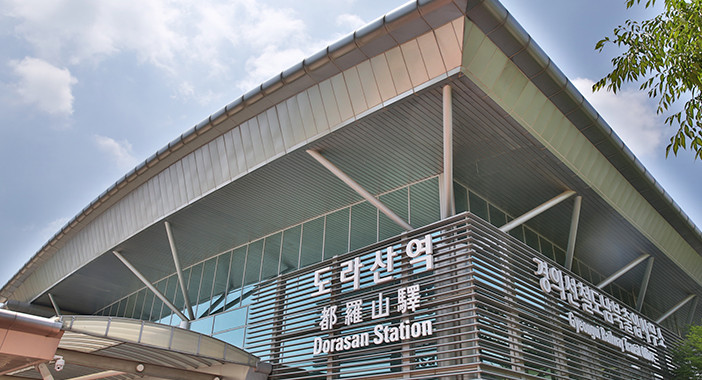
The final stop on our tour was at Dorsan Station. Dorsan Station is situation on Gyeongui line approximately 710 yards from the DMZ. This railway will one day connect North and South Korea. It was amazing to see such a hopeful symbol for reunification of North and South Korea.
To leave the DMZ, we had to, again, show our passports to armed guards *I was breathing heavily*. We passed through and headed back to Seoul. I would highly recommend going to the DMZ if you go to Seoul. It was something I was very nervous about exploring, but ultimately a wonderful experience!


Comments